For a business executive, healthcare provider, or high-profile individual in the Houston metropolitan area, few moments are more destabilizing than discovering you are the subject of a federal investigation. Whether it begins with a knock on the door of your River Oaks home at dawn, a team of armed agents entering your Galleria-area corporate office, or a formal grand jury subpoena delivered to your registered agent, the reality is immediate: you are facing the immense, resource-rich machinery of the United States government.
An investigation handled in the Southern District of Texas (SDTX) carries unique complexities. As one of the busiest federal districts in the nation, spanning from the Houston division courtrooms on Rusk Street down to the international border, the prosecutors and agents operating here are highly specialized. They routinely secure sweeping indictments for white-collar crimes, healthcare fraud, tax evasion, corporate non-compliance, and public corruption.
When federal law enforcement focuses its attention on you, the actions you take in the first 24 to 48 hours can completely dictate the outcome of your case. Missteps during this critical window can turn a manageable regulatory issue into a multi-count criminal indictment. To protect your liberty, your assets, and your professional reputation, you must understand the rules of engagement and the necessity of retaining an elite Houston federal criminal defense attorney immediately.
The Core Differentiator: Pre-Indictment Intervention
In state-level criminal defense, an attorney is often retained after an arrest has been made. In the federal system, the dynamic is entirely different. The true measure of elite defense work is preventing the indictment from ever happening in the first place.
The United States Department of Justice (DOJ) rarely rushes to an indictment. Instead, federal agencies spend months, sometimes years, quietly building a case. They compile bank records, intercept communications, interview former employees, and map out corporate hierarchies before you ever realize you are in their crosshairs.
By the time you are formally notified via a target letter, a search warrant, or a subpoena, the government has already built a narrative.
The primary objective of an elite federal criminal defense lawyer is to intervene during this investigative phase. Resolving these high-stakes matters quietly, without public embarrassment, and with zero charges being filed is the highest standard of success.
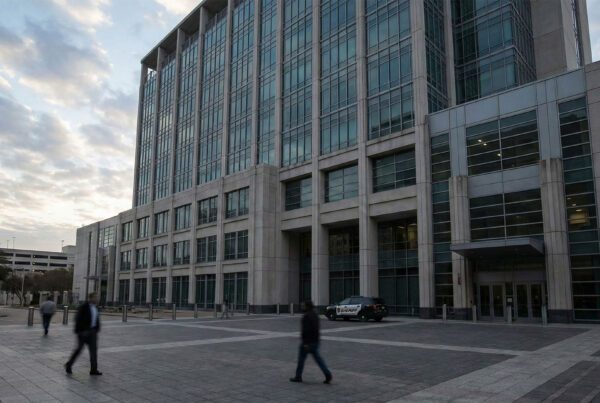
Once an indictment is unsealed in the Bob Casey U.S. Courthouse in downtown Houston, the fight shifts to a highly structured, uphill public battle. However, during the pre-indictment phase, an experienced defense team can directly communicate with the assigned Assistant U.S. Attorney (AUSA). Through strategic dialogue, we can determine your exact status, assess the scope of the government’s evidence, protect your assets from sudden seizure, and present powerful legal and factual counter-arguments that can convince the government to drop the investigation or decline prosecution entirely.
The Shock Drop: When Agents Execute a Federal Search Warrant
A federal search warrant is not an invitation to a casual conversation. It is a court-authorized command allowing federal agents—whether from the FBI, IRS Criminal Investigation (IRS-CI), DEA, or the Department of Health and Human Services Office of Inspector General (HHS-OIG)—to forcibly enter a property and seize physical or digital evidence.
If federal agents execute a warrant at your Houston office or residence, you must execute a strict legal protocol to protect your rights:
1. Demand to See the Warrant and Credentials
You have the legal right to read the search warrant. Verify that it is signed by a federal magistrate judge and check that the address and target areas exactly match your property. Note the names, badge numbers, and agency affiliations of the leading agents.
2. Assert Your Right to Remain Silent
Politely but firmly state: “I want to cooperate with your legal process, but I am invoking my right to remain silent, and I will not answer any questions without my attorney present.” Repeat this phrase like a mantra. Do not try to explain away anomalies or give casual context.
3. Contact an Elite Houston Federal Defense Attorney
Do not wait for the search to conclude. Call your legal counsel immediately. An experienced federal attorney can speak directly with the agent-in-charge or the handling AUSA over the phone to establish legal boundaries and, if possible, travel directly to the scene to monitor the execution of the warrant.
4. Observe Quietly and Do Not Obstruct
Do not physically block agents, hide items, or attempt to delete digital files. Doing so invites immediate arrest for obstruction of justice. Instead, quietly observe what areas they search and what items they pack. Request a copy of the inventory form (Form AO 93) before they depart.
Navigating the Southern District of Texas: Targets, Subjects, and Witnesses
If you are contacted by federal law enforcement, the agent may try to put you at ease by claiming, “You aren’t in any trouble; we just want to ask you a few questions as a witness.”
In the federal ecosystem, individuals involved in an investigation are generally classified into three distinct categories by the DOJ. Understanding where you stand is vital, but you must remember that these classifications are entirely fluid:
- Target: A person or entity as to which the prosecutor or the grand jury has substantial, explicit evidence linking them to the commission of a federal crime. If you are a target, an indictment is actively being pursued.
- Subject: A person whose conduct is within the scope of the grand jury’s investigation. Essentially, the government has not yet decided whether to indict you, but you are under intense scrutiny. A subject can become a target in the span of a single interview.
- Witness: A person who has information aligned with a federal investigation but is not currently suspected of criminal wrongdoing.
Never take an agent’s verbal assurance of your status at face value. The DOJ frequently utilizes “Target Letters” to formally advise individuals that they are the focus of a grand jury investigation. If you receive a target letter from the U.S. Attorney’s Office in Houston, it often contains an invitation to testify before the grand jury or contact the prosecutor.
Do not contact the prosecutor yourself. Any statement you make can, and will, be used to finalize the indictment against you. Your defense lawyer must handle all communications to shield you from exposure.
The Grand Jury Subpoena: Document Demands vs. Personal Testimony
A grand jury subpoena is another primary tool used by federal prosecutors in the Southern District of Texas. These subpoenas fall into two categories: a subpoena ad testificandum (commanding you to appear and testify under oath) or a subpoena duces tecum (commanding you or your business to produce specific documents, emails, or financial records).
Receiving a subpoena requires careful legal management. You cannot simply ignore it, as doing so can result in a contempt of court charge. However, complying blindly without legal oversight can be equally ruinous.
Subpoenas for Corporate Records
If your business receives a subpoena for corporate records, the entity itself cannot assert a Fifth Amendment privilege against self-incrimination to withhold documents. However, the process of collecting, reviewing, and producing those documents must be handled by an experienced attorney.
We must implement a strict legal hold to preserve data, review files for attorney-client privilege, and negotiate with the AUSA to narrow the scope of the request. Broad, overreaching subpoenas can disrupt business operations and hand the government a roadmap to secondary charges if not aggressively contested.
Subpoenas for Personal Testimony
If you are subpoenaed to testify before a federal grand jury at the courthouse on Rusk Street, you must go into that room meticulously prepared. Your defense attorney is not permitted to sit next to you inside the grand jury room. You must face the prosecutor and the grand jurors alone.
However, you have the absolute right to have your attorney waiting right outside the door. During questioning, you have the right to pause the proceedings, step outside the room, and consult with your defense counsel before answering any question. An elite defense lawyer will prepare you on how to handle this environment and instruct you on when and how to properly invoke your Fifth Amendment privilege to prevent self-incrimination.
The Danger of "Just Talking": Avoiding Federal Obstruction and False Statement Charges
The single most common mistake made by highly successful individuals under federal investigation is the belief that they can sit down with agents and logically explain away the problem. They believe that because they are articulate, intelligent, and influential in the Houston business community, they can manage the situation.
This line of thinking is frequently catastrophic.
When you sit down with federal agents, you are rarely dealing with an investigator who is looking for the objective truth; you are speaking to an agent who has already formed a theory of the case and is looking for admissions to validate that theory.
Furthermore, federal agents are legally allowed to use deception during interviews. They can imply they know more than they do, or claim they have evidence they do not actually possess, all to induce an incriminating statement.
The Traps of 18 U.S.C. § 1001
Even if you believe you are completely innocent, a casual conversation can lead to your downfall under 18 U.S.C. § 1001. This federal statute makes it a felony to knowingly and willfully make a materially false statement to a federal agent.
18 U.S.C. § 1001 Traps:
- It is a felony to lie to a federal agent, even if you are not under oath.
- Agents do not need to record the interview; they rely on their own written notes (Form FD-302).
- If your memory of an event from three years ago differs slightly from a document in their possession, they can charge you with a felony false statement.
- The government frequently uses § 1001 to secure convictions when the underlying fraud or white-collar crime is too difficult to prove.
If you speak to agents without counsel, you are gambling with your freedom. The moment an agent asks to speak with you, your sole response must be to redirect them to your legal counsel. This removes you from the line of fire and ensures that all future communications are handled via “attorney-client proffer” or structured legal channels where your rights are fully preserved.
Why Local Houston Federal Defense Experience Matters
The federal criminal justice system is completely distinct from the Texas state court system. The Federal Rules of Criminal Procedure, the Federal Rules of Evidence, and the complex United States Sentencing Guidelines require highly specialized, daily practice.
Furthermore, local familiarity with the Southern District of Texas is invaluable. Every federal district has its own legal culture, local rules, and procedural nuances. Knowing how the specific judges in the Houston division interpret sentencing variances, understanding the prosecutorial tendencies of the local white-collar or healthcare fraud units, and maintaining a reputation for absolute integrity within the local legal community are assets that cannot be replicated by out-of-state firms.
An elite local defense firm brings decades of trial-tested authority directly to your defense. When a firm has a proven record of taking complex federal cases to trial and winning high-profile acquittals, the prosecutors know it. This courtroom credibility completely changes the dynamic of pre-indictment negotiations. It forces the government to bring its absolute sharpest arguments to the table, and frequently opens the door to favorable pre-charge resolutions that a less experienced firm could never secure.
Immediate Steps to Take If You Suspect an Investigation Is Underway
If you have reason to believe that you, your medical practice, or your corporation is currently the subject of a federal inquiry in Houston, you cannot afford to adopt a passive, “wait-and-see” strategy. Immediate, proactive measures are required:
- Retain Counsel Immediately: Do not wait for a formal target letter or an arrest. Secure an elite federal defense team with deep roots in the Houston legal community.
- Cease All Internal and External Discussions: Do not discuss the matter with colleagues, business partners, employees, or friends. These individuals can be subpoenaed by a grand jury and forced to testify about what you said to them.
- Preserve All Potential Evidence: Do not delete emails, destroy hard drives, or alter financial ledgers. Implementing a strict data preservation protocol protects you against catastrophic allegations of obstruction of justice or destruction of evidence.
- Allow Your Attorney to Establish Intercepts: Your legal counsel will immediately send formal letters of representation to the U.S. Attorney’s Office and the investigative agencies. This forces the government to route all future inquiries, subpoenas, and communications directly through your defense team, shielding you from unannounced interactions.
Facing the federal government is an extraordinary burden, but you do not have to face it undefended. By securing seasoned, high-caliber local counsel at the earliest sign of scrutiny, you level the playing field and maximize your opportunity to resolve the matter decisively, quietly, and successfully.
Federal Investigation FAQs
Question: Do I have to let federal agents into my home or office if they do not have a search warrant?
No. If federal agents knock on your door and do not possess a valid search warrant signed by a judge, you are under no legal obligation to let them enter or to speak with them. Politely inform them that you will not consent to a search or an interview without your attorney present, close the door, and contact an experienced federal defense lawyer immediately.
Question: What is the difference between a state crime and a federal crime in Texas?
Federal crimes involve violations of federal statutes passed by Congress, or offenses that cross state lines, impact interstate commerce, or involve federal agencies, federal funds, or federal property (such as mail fraud, wire fraud, bank fraud, and healthcare fraud targeting Medicare). State crimes involve violations of the Texas Penal Code and are prosecuted by local District Attorneys in county courts. Federal investigations typically involve far greater resources, longer investigative periods, and significantly harsher sentencing guidelines.
Question: Can a federal grand jury subpoena be challenged or narrowed?
Yes. Your defense attorney can file a Motion to Quash or negotiate directly with the handling Assistant U.S. Attorney to modify the subpoena. If a subpoena is overly broad, vague, or requests documents that are protected by attorney-client privilege, we can aggressively advocate to narrow the scope of production, saving your business time and limiting your legal exposure.