
A Driving While Intoxicated (DWI) arrest in Texas is an overwhelming, disorienting experience. In a matter of minutes, a routine evening can devolve into flashing emergency lights, roadside interrogations, handcuffs, and a night in a jail cell. For professionals, executives, commercial drivers, and everyday citizens across the state, the initial shock of an arrest is quickly replaced by dread regarding what comes next: Will I lose my driver’s license? Will I lose my professional credentials? Will I go to jail?
In Texas, the criminal justice system is exceptionally punitive when dealing with alcohol- and drug-related driving offenses. The state enforces strict statutory minimums, aggressive prosecution strategies, and administrative processes engineered to penalize drivers long before a jury ever hears a single piece of evidence.
A DWI charge is not a simple traffic citation; it is a serious criminal accusation that threatens your freedom, financial security, and personal reputation. Navigating the treacherous waters of Texas DWI law requires far more than passive representation or a standard plea agreement. It demands elite, trial-tested courtroom advocacy capable of dismantling the state’s forensic evidence, challenging law enforcement procedure, and protecting your constitutional rights.
Quick Read: Critical Takeaways on Texas DWI Defense
- Immediate Action Required: You have exactly 15 days from the date of your arrest to request an Administrative License Revocation (ALR) hearing to prevent the automatic suspension of your driver’s license.
- Forensic Fallibility: Breathalyzers and blood draws are scientific tests subject to human error, machine calibration defects, chemical contamination, and strict chain-of-custody protocols that can be legally challenged.
- Constitutional Protections: Police officers must establish reasonable suspicion for the initial traffic stop and probable cause for the arrest; any constitutional breach can lead to suppressed evidence and dismissed charges.
- Severe Long-Term Penalties: A Texas DWI conviction results in permanent criminal records, substantial state surcharges, mandatory ignition interlock devices, soaring insurance premiums, and potential incarceration.
- Trial Readiness Matters: Elite defense attorneys do not simply negotiate plea deals; they prepare every case for trial, exposing evidentiary weaknesses to secure dismissals, charge reductions, or acquittals.
Anatomy of a Texas DWI Charge: What the State Must Prove
Under Section 49.04 of the Texas Penal Code, an individual commits the offense of Driving While Intoxicated if they are intoxicated while operating a motor vehicle in a public place. While this statutory definition appears straightforward, every component of the law contains nuanced legal definitions that a skilled defense attorney can challenge.
Defining “Intoxication” Under Texas Law
Texas law establishes two distinct legal standards for intoxication:
- The Impairment Standard: The loss of the normal use of mental or physical faculties by reason of the introduction of alcohol, a controlled substance, a drug, a dangerous drug, a combination of two or more of those substances, or any other substance into the body.
- The Per Se Standard: Having an alcohol concentration of 0.08 or more in breath, blood, or urine at the time of operating the vehicle.
Proving intoxication requires the state to present admissible, reliable evidence. The prosecution relies heavily on subjective police observations, standardized field sobriety tests, and chemical test results. An experienced defense attorney systematically dissects each category of evidence to reveal inconsistencies and procedural failures.
The Two Fronts of a DWI: Administrative vs. Criminal Proceedings
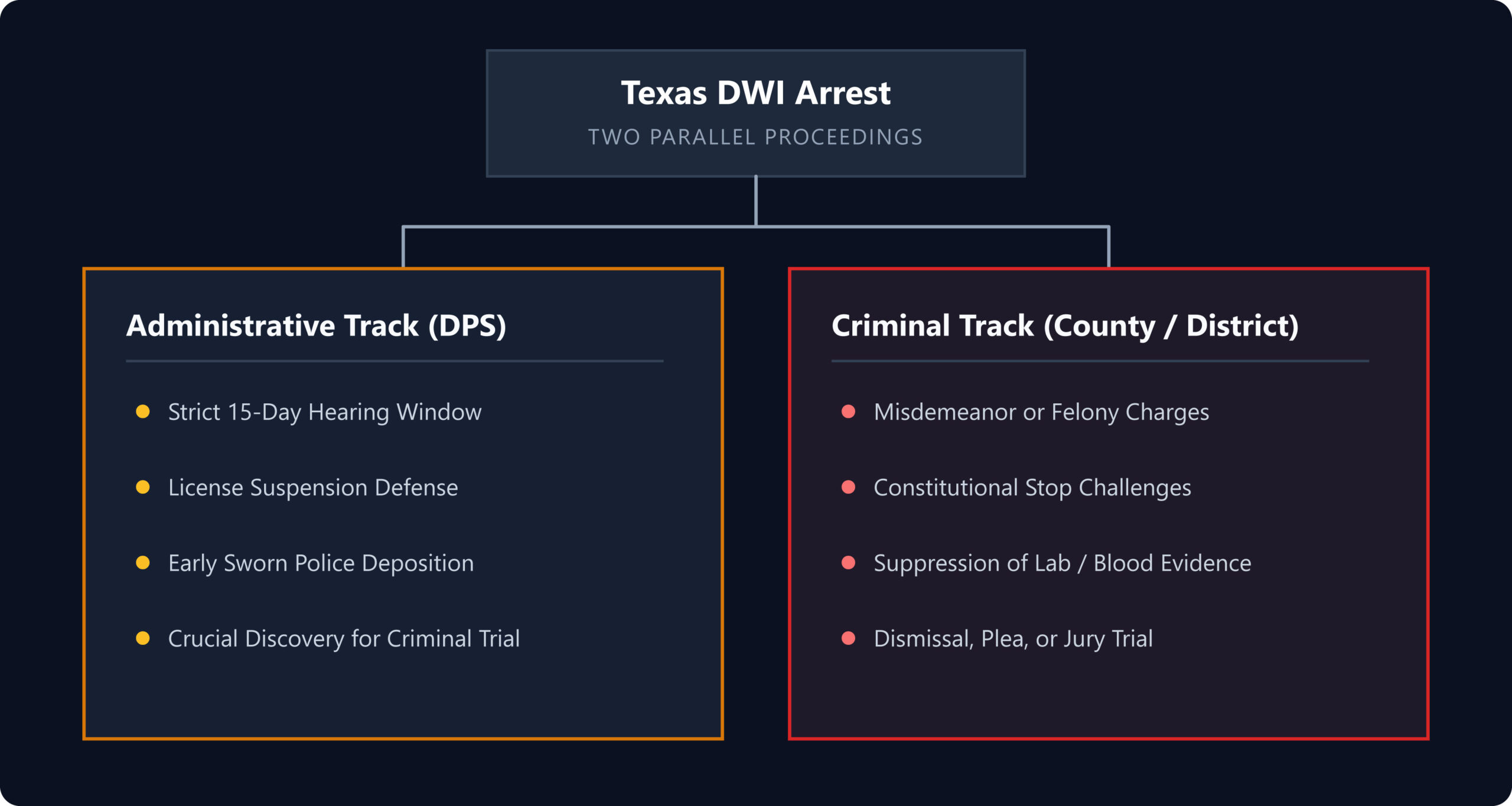
A Texas DWI arrest immediately triggers two completely separate legal proceedings: the Administrative License Revocation (ALR) process handled by the Texas Department of Public Safety (DPS), and the Criminal Case prosecuted in county or district court.
The 15-Day ALR Deadline
When an individual is arrested for DWI and either refuses to submit to a chemical breath or blood test, or provides a specimen with an alcohol concentration of 0.08 or greater, DPS initiates an administrative suspension of their driving privileges.
- The Clock Is Ticking: The accused has 15 calendar days from the date the Notice of Suspension (Form DIC-25) is served to formally request an ALR hearing.
- Failure to Request: If a hearing is not requested within this 15-day window, the right to contest the suspension is waived, and the driver’s license is automatically suspended on the 40th day after notice was received.
Strategic Value of the ALR Hearing
Many defendants assume the ALR hearing is merely a procedural hurdle. In the hands of a skilled defense lawyer, the ALR hearing serves as a vital tactical tool. It provides an opportunity to subpoena the arresting officer and cross-examine them under oath months before the criminal trial begins. The sworn testimony obtained during this hearing locks the officer into their narrative, exposes contradictions in the police report, and provides essential discovery that can be leveraged to win the criminal case.
Texas DWI Penalties and Consequences
The severity of a DWI charge in Texas depends on several factors, including prior convictions, blood alcohol concentration levels, and whether aggravating circumstances were present at the time of the arrest.
| Offense Level | Classification | Incarceration Range | Maximum Fine | License Suspension |
| 1st Offense (BAC < 0.15) | Class B Misdemeanor | 72 hours to 180 days | Up to $2,000 | 90 days to 1 year |
| 1st Offense (BAC ≥ 0.15) | Class A Misdemeanor | Up to 1 year | Up to $4,000 | Up to 1 year |
| 2nd Offense | Class A Misdemeanor | 30 days to 1 year | Up to $4,000 | 180 days to 2 years |
| 3rd Offense or More | 3rd Degree Felony | 2 to 10 years (TDCJ) | Up to $10,000 | 180 days to 2 years |
| DWI with Child Passenger (< 15 yrs) | State Jail Felony | 6 months to 2 years | Up to $10,000 | Up to 180 days |
| Intoxication Assault (Serious Bodily Injury) | 3rd Degree Felony | 2 to 10 years | Up to $10,000 | Up to 2 years |
| Intoxication Manslaughter (Fatality) | 2nd Degree Felony | 2 to 20 years | Up to $10,000 | Up to 2 years |
Hidden and Collateral Consequences
Beyond direct statutory penalties, a DWI conviction carries collateral consequences that can disrupt every facet of your life:
- Texas Annual Super Fines: Texas imposes state traffic fines upon conviction of $3,000 for a first offense, $4,500 for a second offense, and $6,000 for a high-BAC offense (BAC ≥ 0.15).
- Ignition Interlock Devices (IID): Installation and monthly maintenance costs for a vehicle breathalyzer device.
- Insurance Ramifications: Skyrocketing premiums and the mandatory filing of SR-22 high-risk insurance certificates.
- Professional Licensure: Disciplinary actions, suspension, or revocation of licenses for doctors, nurses, attorneys, pilots, accountants, and real estate professionals.
- Career and Employment Barriers: Inability to pass corporate background checks, security clearances, or drive commercial/company vehicles.
Pillars of an Elite Texas DWI Defense
Securing an optimal outcome in a DWI case requires a comprehensive defense strategy built on forensic analysis, constitutional law, and aggressive trial preparation.
1. Challenging the Initial Traffic Stop (Fourth Amendment)
The Fourth Amendment of the U.S. Constitution and Article I, Section 9 of the Texas Constitution protect citizens against unreasonable searches and seizures. A law enforcement officer cannot stop a vehicle based on a hunch or suspicion.
- Reasonable Suspicion: The officer must possess specific, articulable facts that reasonably warrant the suspicion that the driver has committed, or is about to commit, a traffic violation or criminal offense.
- Motion to Suppress: If the defense demonstrates that the traffic stop lacked reasonable suspicion—such as a minor lane deviation that did not violate the Texas Transportation Code—the court must suppress all evidence obtained after the stop. Without this evidence, the state is forced to dismiss the charges.
2. Deconstructing Standardized Field Sobriety Tests (SFSTs)
The National Highway Traffic Safety Administration (NHTSA) developed a battery of three standardized tests used by law enforcement to evaluate impairment:
- Horizontal Gaze Nystagmus (HGN): Tracking involuntary jerking of the eyes as they follow an object horizontally.
- Walk and Turn (WAT): A divided-attention physical test involving nine heel-to-toe steps along a straight line, turning, and returning.
- One Leg Stand (OLS): Standing on one foot while counting aloud for thirty seconds.
Field sobriety tests are designed for failure. An experienced defense lawyer exposes how environmental and physical factors compromise the validity of SFST results:
- Environmental Conditions: Uneven pavement, gravel, heavy traffic, darkness, inclement weather, and flashing cruiser strobe lights.
- Physical Limitations: Individuals over 50 pounds overweight, those aged 65 and older, or individuals with back, leg, knee, or inner-ear conditions are medically disqualified from performing these tests accurately according to NHTSA guidelines.
- Officer Error: Failing to properly administer standardized instructions, improperly positioning the stimulus during the HGN test, or grading normal human movements as signs of intoxication.
3. Attacking Chemical and Breathalyzer Evidence
Texas prosecutors frequently treat breathalyzer tests (such as the Intoxilyzer 9000) as incontrovertible proof of guilt. However, breath testing machines are mechanical instruments that do not directly measure blood alcohol; they calculate an estimate based on a mathematical conversion factor known as the partition ratio.
Common defenses against breath test evidence include:
- Mouth Alcohol and GERD: Gastroesophageal Reflux Disease (GERD), acid reflux, or dental work can trap alcohol in the esophagus or mouth, causing the machine to register a false, astronomically high BAC reading.
- Calibration and Maintenance Failures: Breath test machines must undergo rigorous, regular calibration and maintenance by certified technical supervisors. Any gap in records, software errors, or reference solution inaccuracies renders the result unreliable.
- The 15-Minute Observation Period: Officers must continuously observe the suspect for a full 15 minutes before administering the test to ensure they do not burp, regurgitate, or ingest anything. Failure to adhere strictly to this protocol invalidates the sample.
4. Auditing Blood Draws and Laboratory Toxicology
In recent years, law enforcement agencies across Texas have shifted heavily toward mandatory “No Refusal” blood draws, obtaining electronic search warrants to draw blood when a suspect declines testing.
A blood sample is susceptible to biological, chemical, and human contamination. A premier defense requires a comprehensive audit of the entire analytical process:
- Site Preparation: The draw site must be cleaned with a non-alcoholic swab. The use of an ethanol-based disinfectant will contaminate the sample and artificially inflate BAC readings.
- Tube Expiration and Preservatives: Blood collection vials contain specific chemical agents: sodium fluoride (a preservative) and potassium oxalate (an anticoagulant). If the tube is expired, improperly inverted, or contains insufficient preservative, microbes and yeast will thrive in the blood, causing in vitro fermentation that manufactures endogenous alcohol inside the sealed tube.
- Chain of Custody and Storage: Blood samples must be continuously refrigerated and tracked. Gaps in the chain of custody, improper temperature control, or delays in lab submission can cause sample degradation.
- Headspace Gas Chromatography Errors: Crime laboratories use gas chromatography to measure blood alcohol concentration. Defense counsel must independently inspect the lab’s calibration curves, blank runs, integration parameters, and instrument error logs to challenge false positives and machine drift.
Pre-Trial Motions: Winning the Case Before Trial
An elite defense strategy rarely waits for the jury selection phase to challenge the state’s case. Decisive victories often occur during pre-trial motion practice.
- Motion to Suppress the Stop: Establishes that the traffic stop violated constitutional protections, excluding dashcam footage, officer statements, and field sobriety observations.
- Motion to Suppress Blood Search Warrant: Challenges the “four corners” of the warrant affidavit, proving the magistrate lacked sufficient probable cause to issue the warrant.
- Motion to Exclude Chemical Results (Daubert/Kelly Challenges): Challenges the scientific reliability of the state’s laboratory methodology or the qualifications of the state’s toxicologist.
- Motion in Limine: Precludes the prosecution from mentioning prejudicial, irrelevant, or unproven allegations during trial without prior court approval.
Why Generalist Representation Falls Short
Many criminal defense attorneys treat DWI cases as routine matters, reviewing the police report briefly before negotiating a standard probation agreement. This approach fails to serve the client’s best interests.
DWI litigation is a distinct, scientifically complex area of criminal law. It sits at the intersection of:
- Constitutional search-and-seizure jurisprudence.
- Advanced organic chemistry and toxicology.
- Human biology, anatomy, and pharmacokinetics.
- Electronic and mechanical instrumentation.
Navigating this terrain requires an attorney who regularly cross-examines state toxicologists, understands gas chromatography software, commands courtroom mastery of police procedure manuals, and possesses a demonstrated record of winning jury trials.
When prosecutors face a defense team with a reputation for taking cases to trial and dismantling state evidence, the entire dynamic changes. Cases that appear open-and-shut on paper are frequently dismissed, reduced to non-alcohol-related traffic offenses, or resolved with complete acquittals in front of a jury.
Essential Steps to Take Following a Texas DWI Arrest
The hours and days following a DWI arrest are critical. Taking the right steps immediately can significantly improve your defense:
- Exercise Your Right to Remain Silent: Do not discuss the events leading to your arrest, how much you had to drink, or where you were coming from with anyone other than your attorney.
- Request Your ALR Hearing Immediately: Do not let the 15-day administrative deadline expire. Retain legal counsel immediately to file this request and preserve your driving privileges.
- Document Everything You Remember: Write down every detail of your encounter while it is fresh in your memory: the weather, road conditions, exact statements made by the officer, the duration of field tests, and any medical conditions or physical discomfort you experienced.
- Obtain Medical Records: If you have back, knee, inner-ear problems, or acid reflux, secure documentation from your physician to substantiate physical challenges during roadside testing.
- Secure Elite Legal Counsel: Retain a law firm with a proven track record of litigating high-stakes DWI charges, fighting chemical evidence, and defending your rights in court.
Your future, your career, and your freedom are too valuable to leave to chance. When facing a Texas DWI, having an elite, trial-tested defense team on your side is the single most important decision you will make.
Frequently Asked Questions (FAQ)
Can I refuse a field sobriety test in Texas?
Yes. Standardized Field Sobriety Tests (SFSTs) are completely voluntary under Texas law. You are not legally required to perform roadside balance, coordination, or eye tests, and there is no statutory driver’s license suspension penalty solely for declining them.
What is the difference between a breath test refusal and a blood warrant?
If you refuse a voluntary breath or blood test, the state will initiate an administrative license suspension. However, in many jurisdictions, officers can immediately apply for an electronic search warrant signed by a judge, which legally authorizes them to draw your blood without your consent.
Can a DWI be expunged or sealed in Texas?
Under the Texas Second Chance Law, certain first-time DWI offenders who meet strict criteria (such as having a BAC under 0.15, completing all sentence requirements, and having no prior criminal convictions) may petition the court for an Order of Nondisclosure, which seals the record from public view. Outright expunction is available if the case is dismissed or resulted in an acquittal at trial.
How long will a DWI stay on my record in Texas?
In Texas, a criminal conviction remains on your record permanently unless the charges are dismissed, acquitted at trial, or successfully sealed via an Order of Nondisclosure.